Even as an Insect, Gregor Samsa Doesn’t Want to Be an Inconvenience
When I first read Franz Kafka’s The Metamorphosis in high school and again in college almost a decade ago, what stayed with me was how quickly the protagonist, Gregor Samsa, lost his place in his family after he could no longer provide for them financially. I understood the story largely through the lens of conditional worth, in which people are valued for what they produce, and their treatment can change when they are no longer useful. Gregor’s transformation made that possibility hard to ignore, notably because his years of supporting the household seemed to offer virtually no protection against his eventual rejection.
Returning to the story as an adult, I pay closer attention to how Gregor understands rejection and how much of his family’s judgment he has internalized. His concern for their well-being continues even as his condition deteriorates, and he struggles to see his need for care as legitimate. These details deepen my earlier reading, raising questions about dependence, belonging, and the difficulty of expressing needs that change how others see us. They also help explain why the novella upholds relevancy more than a century after its publication, as the expectations influencing Gregor’s relationships are recognizable in contemporary social life.
Kafka introduces these concerns through Gregor’s response to his transformation. Upon waking to find himself changed into a monstrous, insect-like creature, Gregor struggles to understand and move his unfamiliar body; however, much of his attention is on getting to work. He worries about missing his train, upsetting his employer, and, consequently, failing to provide for his family. His reaction is unusual given the circumstances, but it establishes a recurring pattern in the story: Gregor understands his own needs in terms of how they affect his responsibilities to others.
Gregor is the family’s primary breadwinner, supporting his parents and younger sister, Grete, while repaying his parents’ debt to his employer. He dislikes his job and often considers leaving, yet he believes he must persist until the debt is paid. His role as a provider gives him a concrete purpose within the household, but it also begins to define how he understands his place within it. After his transmutation, his inability to work changes both how the family treats him and how he views himself. Therefore, it is reasonable to suggest that his sense of worth has become closely tied to his ability to provide.
The association between usefulness and personal worth can also affect relationships where a person’s contribution is unrelated to income. Consider a friend accustomed to listening to everyone else’s problems but who hesitates to discuss their own loneliness, or a debt-ridden adult who reassures their family that they are managing well because they fear causing concern. In these examples, dependability is how one understands their place in a relationship. Asking for support may then feel like failing to be the person others expect. Gregor’s circumstances thus allow us to examine how a person who has learned to care for others comes to see their own need for care as unacceptable.
Before the metamorphosis, Gregor already knows that his work makes him unhappy. He describes exhausting travel, irregular meals, and brief encounters with people he has few and far-between opportunities to know. He also imagines confronting his employer and resigning after he has repaid the debt, which he estimates will take another five or six years. These thoughts demonstrate that Gregor has preferences and desires beyond his responsibilities. However, and most notably, he consistently postpones acting on them—it is established that choosing a different life depends on first meeting his family’s financial needs.
Gregor’s situation, therefore, concerns more than a demanding job, as leaving it would affect the people he supports as well as his own income. This helps explain why he keeps working despite his dissatisfaction, but it also shows how burdensome it has become to consider his needs separately from theirs. When he wakes in a different body, he continues to reason within the same expectations. Even in an alien body, his first task is still to get up and make himself available for work!
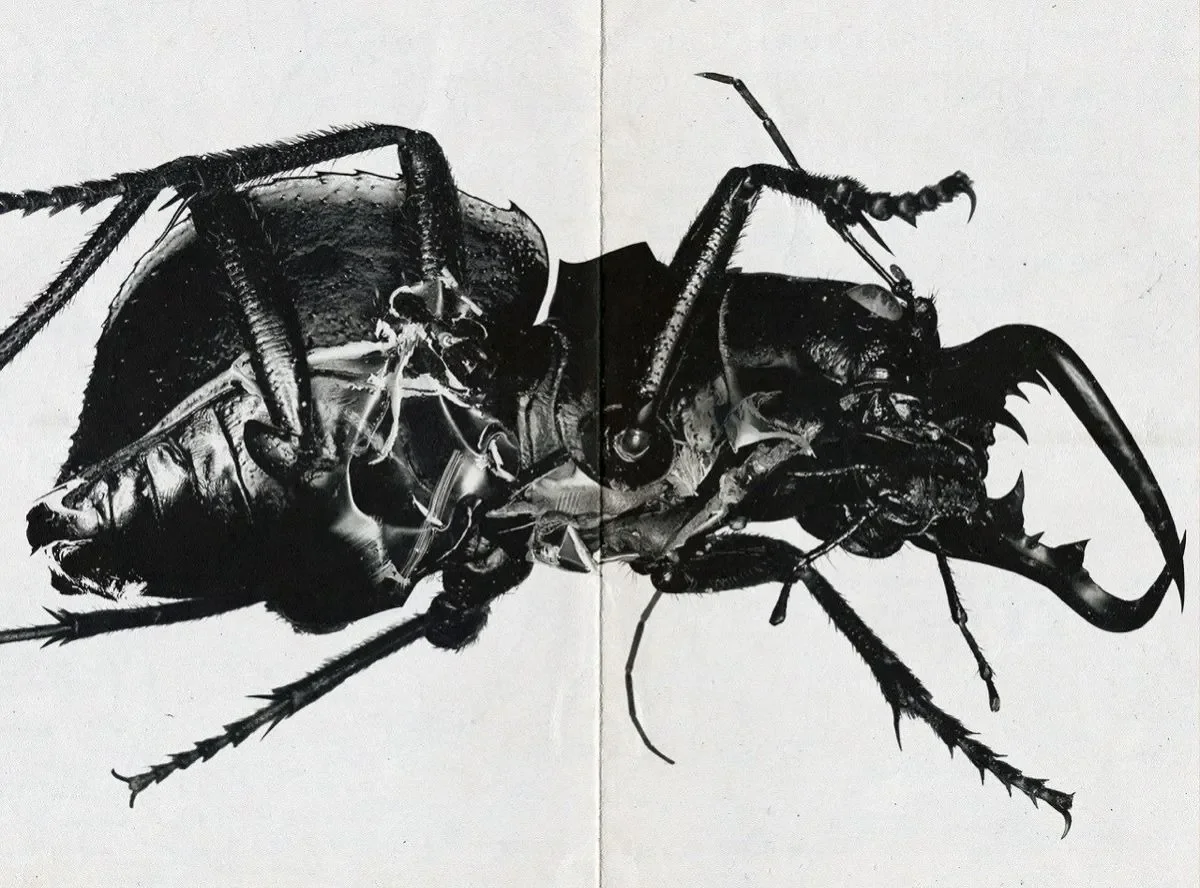
Massive Attack, Mezzanine album artwork(1998)
Photography by Nick Knight; art direction by Tom Hingston and Robert Del Naja. Sourced from Virgin Records.
After Gregor fails to appear for work, the company’s chief clerk arrives at the apartment and demands an explanation. The clerk interprets Gregor’s absence and refusal to open the door as signs of misconduct. He criticizes Gregor’s recent performance and warns him:
“And nor is your position all that secure.”
This is a significant reaction (occurring before the clerk even sees Gregor’s condition) in that an unexplained absence is already treated as evidence of Gregor’s unreliability, despite his previous work record. Gregor responds by minimizing what has happened and promising to resume his duties. He describes himself as only temporarily unwell, although he has struggled to perform basic movements, thereby indicating that he has accepted the expectation that illness should be overcome quickly to avoid interrupting work. Rather than asking the clerk to recognize the extent of his ludicrous condition, he tries to persuade him that the disruption will be minimal. His concern about appearing unreliable consequently takes priority over explaining what he needs.
Gregor’s reluctance to acknowledge his difficulties raises a broader question about what people feel able to admit when they fear losing others’ respect. Consider an earlier example: the dilemma of telling a friend that you feel lonely. Doing so involves acknowledging an unmet need for connection while risking the possibility that such a friend will interpret it as a personal failing. In an analysis of the BBC Loneliness Experiment, Barreto and colleagues found that younger participants reported more perceived community stigma, greater shame, and a stronger inclination to conceal loneliness than older participants. The study used a self-selected sample, so these differences should not be taken as descriptions of every young or older person. They nevertheless show why acknowledging a need for connection can be challenging. Gregor’s efforts to minimize his condition reflect a similar concern about how others will interpret it, albeit his circumstances and the needs he conceals differ.
Within the family, responses to Gregor’s metamorphosis vary. His mother initially defends him to the clerk and later wants to see him despite her fear. Grete feeds him, cleans his room, and tries to identify foods he can tolerate. These actions signify that the family’s relationship with Gregor includes affection and concern alongside financial dependence. In previous readings of this work, I assumed they valued him only for his earnings, but these efforts suggest otherwise. Gregor’s memories also show that the family had grown accustomed to his support long before the transformation. When he first began earning enough to help them, his contributions brought them considerable happiness. Over time, however, both giving and receiving the money became routine, and the initial warmth withered. This change does not necessarily mean that the family stopped caring about him. It does suggest, however, that his work had become an ordinary expectation of family life. Once an arrangement is taken for granted, the effort needed to maintain it can receive less attention than the problems that arise when it fails.
After the metamorphosis, Gregor learns that his father had kept a small sum from his former business and had saved part of Gregor’s earnings. The reserve could support the family for perhaps a year or two, though it would not provide lasting financial security. Gregor acknowledges that some of this money could have reduced the debt and allowed him to leave his job sooner. Nevertheless, he approves of his father’s decision to save it. His response shows how readily he places the family’s security ahead of his own relief. Even when he learns that the financial situation was different from what he had assumed, he does not substantially question his responsibility for it.
The family eventually adapts by taking on paid work. His father becomes a bank attendant, his mother sews for a business, and Grete works in a shop while studying to improve her job prospects. Their ability to contribute infers that the previous distribution of responsibility could change. At the same time, their fatigue reveals how grueling the adjustment is. Gregor notices their exhaustion and feels ashamed that they must work; meanwhile, he assumes responsibility for protecting them from hardship. Ironically enough, he is the family member who needs the most assistance.
To understand this emotional response, it is helpful to distinguish dependence from the belief that one is a burden. Here, dependence means needing another person’s material or practical support. Being regarded as a burden adds the judgment that those needs make one’s presence undesirable. Gregor’s family depended on his income before the metamorphosis, and he accepted their dependence as part of his duty. When he becomes dependent on them, he struggles to treat his own needs as equally valid. He worries about what his care costs them and tries to make himself less demanding.
His efforts to conceal his body illustrate this concern. After noticing that Grete finds his appearance unsettling, Gregor spends hours arranging a sheet over the sofa so she will not have to see him. He wants to make her visits easier, but doing so also reduces the contact available to him. So, he learns about the household by listening through the door rather than participating in its conversations. His effort to protect others from discomfort hence contributes to his own exclusion. He remains concerned about their reactions while having minimal opportunity to explain his experience.

The tension between wanting contact and trying not to make others uncomfortable can also manifest in everyday friendships, such as when a young adult participates in a group chat but avoids telling friends they feel disconnected. They may continue responding to messages while simultaneously deleting a request to meet because they worry about appearing demanding. This hypothetical situation helps distinguish social contact from the ability to express a need within that contact. A person may appear socially connected while still withholding the very feelings that would reveal their loneliness.
This distinction is also observable in Gregor’s relationship with his family. To preface, being recognized as a family member is not the same as being included in family life. Gregor continues to occupy a room in the apartment, but his access to conversation and companionship depends on whether others permit it. His physical presence does not ensure that anyone asks what he wants or treats his reactions as meaningful. The presence of family or friends only tells us who is available in principle; it does not, on its own, tell whether someone feels understood or able to ask for attention.
Removing the furniture presents another obstacle tied to Gregor’s dependence. Grete believes that clearing the room will give him more space to crawl. His mother worries that doing so would signal they have given up hope that he will recover. Gregor becomes distressed as objects from his earlier life are removed, to the point that he tries to protect the framed picture on the wall. Each response reflects a different understanding of what he needs. Grete focuses on his ability to move, his mother on the likelihood of recovery, and Gregor on staying connected to what matters to him. From this scene, one can assume that practical assistance does not necessarily entail understanding the person receiving it. Grete has observed Gregor’s movements and is responding to a physical need, but she cannot reliably discern what the furniture means to him. Gregor is also adjusting to preferences that have changed alongside those that remain. His inability to communicate makes it even harder for the family to identify this distinction. As a result, decisions about his environment depend on their interpretation of his behavior, while his own wishes receive meager, if any, consideration.
Recent sociological research shows that receiving care can coexist with feeling disconnected and trying to preserve an earlier identity. In a study published in a 2025 issue of The Sociological Review, Neves and Petersen drew on interviews, diaries, and ethnographic data about older people’s loneliness. One participant, identified by the pseudonym Audrey, concealed her move into a care home from friends and continued speaking to them by telephone as though she were still at home. Another, June, told others she enjoyed being alone while privately describing the opposite. These accounts show how people can maintain relationships while withholding experiences that risk how they want to be seen. Gregor’s concealment similarly conveys an attempt to manage others’ reactions while adapting to circumstances that have changed his place among them.
Gregor’s attachments also show that it would be incorrect to describe him as having no personal identity. He remembers his earlier life, cares about his sister, takes pleasure in certain experiences, and becomes angry when he is neglected. These feelings exist even after he loses his economic role. What changes is the family’s willingness or ability to recognize them. The reader has access to thoughts that the other characters cannot hear, making the difference between Gregor’s experience and their assumptions especially apparent. Accordingly, his limited communication does not mean that he has stopped having preferences or understanding what happens around him.
Recognizing Gregor’s continuing needs does not, however, erase the demands placed on the person expected to meet them. Grete’s circumstances help explain some of the changes in his care. At seventeen, she takes on much of Gregor’s daily care and later combines it with paid work. As the story progresses, she becomes less attentive to his food and the cleanliness of his room. She also resents her mother’s attempt to clean it, suggesting her role involves authority as well as obligation. Her behavior reflects several tensions in tandem. She is tired, she has responsibilities outside the home, and she has become accustomed to being the person who decides how Gregor should be treated.
Grete’s struggle to balance these responsibilities invites consideration of the support available outside the family, specifically when care and companionship are expected to come primarily from within the home. In September 2026, the Institute for Public Policy Research published The Loneliest Generation, combining analysis of existing data with conversations with more than 150 young people in England. Participants reported wanting more opportunities to see friends in person and a lack of places to spend time without paying. The report situated disconnection within changes to youth services, public spaces, and the conditions of growing up. This provides a contemporary example of how opportunities for belonging depend on what is available beyond the individual household.
Gregor’s circumstances, though vastly dissimilar from ours—unless the reader has spontaneously transformed into an insect—show what can happen when support depends almost entirely on a single household. As his family becomes less willing to care for him, he has few obvious alternatives. Their inability or unwillingness to meet his needs becomes a reason to regard those needs as his problem.
That dependence becomes even more complicated because the family does not merely respond to Gregor’s condition; at times, their treatment worsens it. For example, his father injures him by throwing an apple that remains lodged in his body, after which Gregor’s mobility is severely reduced. The family’s treatment thus contributes to the difficulties for which he is later blamed. This complicates the view that his condition alone creates their problems. His needs change partly because of the original transformation and partly because of what happens to him afterward. Any account of his dependence must therefore include the effects of both the care he receives and the harm he experiences.
Yet Gregor’s dependence does not erase his attachments to others. His response to Grete’s violin playing provides some of the most noticeable evidence that those attachments exist. He leaves his room because he is drawn to the music, while the paying lodgers show comparatively little interest. The narration asks:
“Was he an animal if music could captivate him so?”
Gregor remembers his plan to pay for Grete to attend a conservatory and imagines telling her what he had intended. The scene connects his appreciation of her playing with his desire to support her. As he imagines renewed closeness, Gregor returns to a contribution he once hoped to make.
His thoughts also contain a desire to keep Grete in his room, although he imagines her staying voluntarily. This makes his attachment more complex than a purely selfless concern for her future. He wants companionship and recognition, and his wish to secure them can become possessive. These contradictions are part of the personal identity that recurs throughout the novella. Gregor still has needs and desires of his own, and simultaneously struggles to acknowledge them without framing them in terms of what he can offer someone else.
The family’s rejection becomes explicit after the lodgers discover Gregor and threaten to leave without paying. Grete argues that they must get rid of him and refuses to accept that the creature is still her brother. She reasons that, if he were Gregor, he would understand their troubles and leave voluntarily. Her argument relies on what she knows about his former behavior, that is, Gregor had consistently put the family’s needs first! She now uses that expectation to explain why his continued presence is unacceptable. Remaining in need of care becomes inconsistent with the version of her brother she is willing to recognize.
Ultimately, Gregor returns to his room and agrees that he must disappear, while still thinking of his family with affection. He dies after a prolonged period of injury, inadequate nourishment, and neglect. Thus, his death cannot be explained solely as a voluntary decision to stop living. His physical condition has deteriorated, and his acceptance of the family’s judgment occurs after repeated experiences of rejection. The connection between these experiences and his final thoughts suggests he has adopted their view of himself as a man whose absence would improve their lives.
After his death, the family feels relief and begins planning for the future. They consider a smaller apartment, discuss their employment prospects, and think about Grete’s eventual marriage. Their renewed optimism shows how strongly Gregor had become associated with the difficulties of their present circumstances. It also shows how little his earlier contributions ultimately protected his place within the family once he could no longer provide. The reader knows that his concern for them persisted, just as their plans for the future depended on his absence.
Gregor’s transformation could be interpreted as expressing a desire to escape his responsibilities, although Kafka does not specify a cause. Its consequences, however, are clear. Gregor becomes unable to work while remaining deeply concerned about his obligations. He continues to judge his behavior by its effect on the household, and he struggles to accept care without feeling responsible for the effort it necessitates. Losing the ability to perform his role does not remove the expectations he has learned to associate with it.
Returning to The Metamorphosis as an adult has truly expanded my earlier understanding of conditional worth. The value placed on what a person produces can also influence whether they feel entitled to care when they can no longer provide it. Gregor’s role is evidently economic, but the challenges he faces also concern belonging—whether he can remain a recognized and valued member of the family when he needs more than he can give. Contemporary examples of concealed loneliness and unmet needs for connection extend this question to friendships, family relationships, and community life, highlighting what people feel able to disclose, whose needs are taken seriously, and what opportunities exist for receiving support. Gregor’s circumstances change absurdly, but his memories, preferences, and attachments endure.
What troubles me now is how gradually Gregor comes to accept that these parts of himself are insufficient to justify the care he needs, despite the care he has long provided to others. This, I think, is part of what makes the novella a classic. Even in 2026, a man waking up as an insect and worrying about being an inconvenience feels oddly familiar.